Culture change isn’t always a program

Most people talk about culture change like it’s a program—something leadership “drives.” In some cases, that’s true. Organizations do set intentions. They launch initiatives. They make deliberate choices about what gets rewarded, what gets resourced, and what “good” looks like.
But culture also changes all the time without intention.
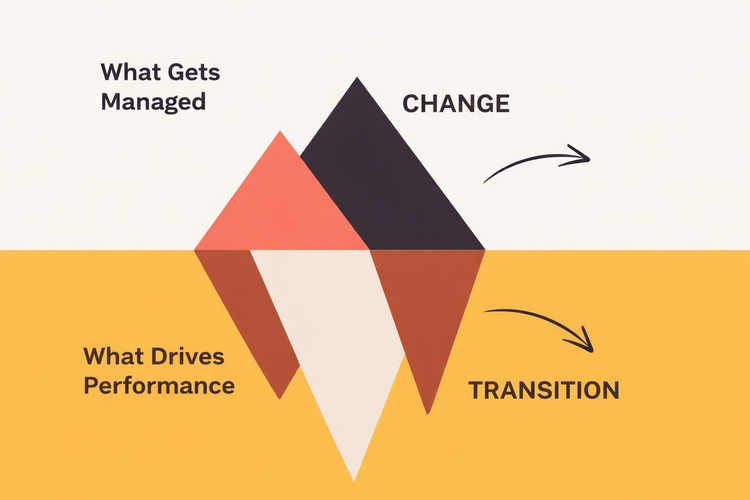
It changes when the work changes. When pace shifts. When tools reshape attention. When decision rights move closer to the edge. When roles blur faster than definitions update. When experienced people leave and new people arrive. No announcement required.
People adapt. And that adaptation accumulates—quietly becoming norms, expectations, and eventually culture.
Where culture shifts without anyone intending it
I’ve seen culture shift many times without a single values conversation taking place. It wasn’t driven by speeches or programs. It happened because conditions changed—and behavior adapted.
A new tool changed where attention went.
A new reporting cadence changed what got rewarded.
A new layer of approvals changed how much risk people were willing to take.
A sustained period of pressure changed what people felt safe saying—and what they kept to themselves.
None of these were framed as culture decisions. They were operational choices. Sensible ones, in most cases. But each one taught people something about how work really worked now.
Over time, those lessons accumulated. Expectations shifted. Norms followed. And culture moved—without anyone ever naming it as such.
That’s why culture change so often feels confusing. People aren’t reacting to what leaders say they value. They’re adapting to what the conditions repeatedly require.
The situation most managers are actually in
This is the environment most managers are leading inside. Not a settled culture, but one that’s still moving. Priorities evolve midstream. Standards vary as the organization experiments. Communication stretches across more channels than it used to. Pressure arrives unevenly—sometimes early, sometimes late, rarely predictably.
And then we tell the manager, “Create a positive climate,” as if climate is something you generate through personality or gravitas alone.
That framing misses the point.
Climate isn’t a vibe. It’s conditions.
Climate isn’t a mood, a tone, or an attitude. It’s the set of conditions people are operating inside right now. It determines what gets noticed, what gets avoided, what feels safe to say, and how mistakes are handled under pressure..
Managers usually can’t control the broader culture—especially while it’s changing—but they can reduce interference locally. They can create a stable pocket inside an unstable environment where focus, energy, and learning remain available.
This doesn’t require grand programs. It shows up in small, practical choices: translating shifting priorities into something usable; making standards explicit instead of implied; creating clean recovery after mistakes so learning doesn’t shut down; protecting attention so urgency doesn’t fragment everything into half-work; surfacing signals early while they’re still cheap to address.
None of that requires a settled culture, but it does require attention to conditions.
The messy middle is the job
This work is rarely neat. Managers are often building clarity while receiving ambiguity themselves. Holding calm while feeling pressure. Encouraging learning while the broader system rewards speed.
That’s why the strongest managers aren’t simply “positive.” They’re protective. They don’t deny that culture is changing; they keep that change from turning into confusion at the team level. Over time, that’s what a strong team climate actually is: conditions that make good work more likely even when the surrounding environment makes it harder.
Parting thought
In a changing culture, climate isn’t about restoring what used to be stable. It’s about creating enough stability for people to perform while things are still becoming clear.
That’s not a soft assignment. That’s leadership in the real world.