The Real Constraint Isn’t Strategy. It’s Execution Capacity.

Every organization has strategy. Priorities are defined. Initiatives are named. Plans are built.
And yet, progress often feels slower than it should.
The issue isn’t a lack of thinking. It’s not a shortage of frameworks, models, or offsite conversations. If anything, there is more access to strategic insight today than ever before.
There are entire industries built around helping organizations define where they want to go. But far fewer are focused on what happens next.
The gap shows up in subtle ways at first. Decisions take longer than expected. Work gets revisited. Teams move, but not always in the same direction. Priorities compete for attention. Meetings multiply, but clarity doesn’t always follow.
Over time, the pattern becomes familiar. Not because people don’t care, but because they’ve seen how easily momentum can stall once execution begins.
Research from McKinsey & Company suggests that poor decision processes cost large organizations hundreds of millions of dollars annually through delays, misalignment, and missed opportunities. But the financial impact only tells part of the story. The deeper cost is in energy—how much effort it takes to move work forward, and how often that effort gets redirected or diluted.
This is where the strategy-execution gap actually lives.
Not in the quality of the strategy itself, but in the conditions required to carry it forward.
Execution is often treated as a downstream activity—something that happens after the “real thinking” is done. In practice, it’s the opposite. Execution is where strategy is tested, shaped, and ultimately proven. It’s where priorities meet real constraints, where assumptions collide with reality, and where alignment either forms or breaks down.
And it’s far more demanding than it looks on paper.
Execution requires decisions to move cleanly across levels. It requires clarity on what matters now versus what can wait. It requires teams to interpret priorities in consistent ways. And it requires leaders to recognize and address the friction that naturally emerges when work becomes real.
Most organizations don’t struggle because people aren’t capable. They struggle because the environment makes it harder than it needs to be to translate intention into action.
That’s why there are so many strategy conversations—and so much less progress than expected.
It’s also why the opportunity is not in creating more strategy, but in strengthening execution capacity.
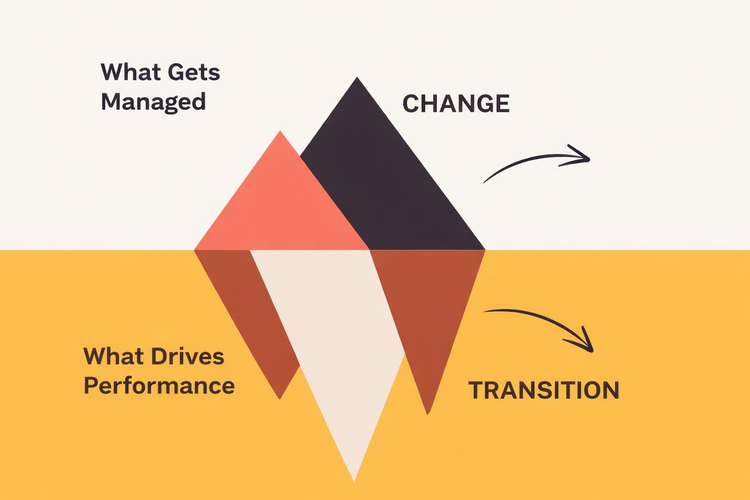
That starts by making the invisible visible. Where are decisions slowing down? Where is work getting reworked? Where is alignment assumed but not actually present? These are not abstract questions. They are observable conditions that shape how effectively strategy moves through an organization.
When those conditions are addressed directly, something shifts. Decisions begin to move with more clarity. Teams spend less time revisiting the same ground. Energy becomes more focused. Progress becomes more consistent.
Strategy doesn’t change. The ability to execute it does.
And that is where real advantage is created.
—
If this made you pause and reflect on how work actually moves in your organization, share it with someone else who is trying to close that gap.