The Coaching Habit That Limits Your Team’s Ability to Adapt

Organizations say they want adaptable teams.
Leaders talk about agility, resilience, navigating uncertainty, responding to change.
But inside most organizations, the way leaders coach their people often trains the opposite.
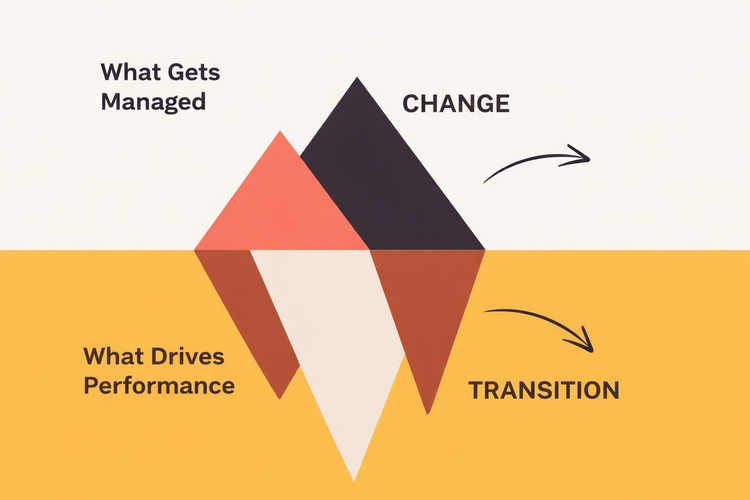
A recent university study found that when leaders coach primarily by giving direction — advice, answers, corrections — people get better at performing known tasks. When leaders coach by helping people think through situations themselves — asking, exploring, reflecting — people become better at handling new ones.
Both approaches improve performance. Just not the same kind of performance.
- One strengthens execution.
- The other builds adaptability.
Most organizations optimize for the first and assume the second will follow.
It rarely does.
Why Telling Works — Until It Doesn’t
When work is stable and repeatable, direction is efficient.
Someone encounters a problem.
A leader provides the answer.
Work moves forward.
It feels productive because it is — in the short term.
But something subtle happens over time. People start looking upward before looking inward. Initiative narrows. Confidence becomes tied to approval. The ability to operate independently weakens, even while output holds steady.
Work gets done.
Until conditions change.
Then the team that once looked high-performing begins to stall, waiting for clarity that hasn’t arrived yet.
Why Thinking Builds Capability
When leaders resist the urge to supply answers and instead help people examine what’s happening, something different develops.
People learn to:
Notice what matters
Interpret conditions
Make decisions with incomplete information
Adjust in real time
They become less dependent on the leader’s presence and more capable in the leader’s absence.
This kind of learning doesn’t always look impressive in the moment. It can feel slower. Less decisive. Even uncomfortable — for both sides.
But it builds something execution alone cannot: the capacity to face situations no one has solved before.
The Anxiety Paradox
One of the more interesting findings in the research was that people coached this way actually reported lower anxiety, not higher.
That may seem counterintuitive. Wouldn’t less direction create more uncertainty?
In practice, the opposite often happens.
Anxiety rises when people feel responsible for outcomes but powerless over how to influence them. Direction can temporarily reduce uncertainty, but it also reinforces dependence.
When people develop the ability to see situations clearly and trust their own judgment, they experience more control even when the environment is unpredictable.
The situation hasn’t become simpler.
They’ve become stronger.
The Tradeoff Leaders Don’t See
Most leaders are under pressure to deliver results now. Direction produces visible progress quickly, so it becomes the default.
But over time, heavy reliance on direction trades long-term capability for short-term efficiency.
Teams become excellent at executing what’s already understood and fragile when faced with what isn’t.
The organization believes it has a performance issue when conditions shift.
In reality, it has a capability gap that formed gradually while things were still working.
A More Useful Role for Leaders
As work becomes less predictable, the leader’s role shifts from being the source of answers to being the designer of conditions where better thinking can happen.
This doesn’t mean abandoning direction. Some work still requires clarity and instruction.
But when the goal is preparing people for what hasn’t happened yet, the leader’s most valuable move is often restraint — creating space for awareness before intervention.
Not because it feels softer.
Because it builds performance that doesn’t depend on constant supervision.
Make the Conditions Driving Your Team Visible
If you’re responsible for performance, it’s not enough to manage tasks — you need visibility into the climate shaping how work actually gets done.
The Six Seconds Team Vital Signs assessment reveals the patterns that influence adaptability, initiative, trust, and execution inside your team — the factors that don’t appear on dashboards but determine whether performance holds under pressure.
If you want a clear picture of what your team is experiencing and what to do next: