
Climate Is Built One Interaction at a Time

Organizations spend a lot of time talking about culture.
Culture appears in mission statements, values posters, and leadership speeches. It shows up in onboarding decks and town hall presentations. It is something companies try to define and reinforce at scale.
But the experience of work is shaped much less by culture and much more by climate.
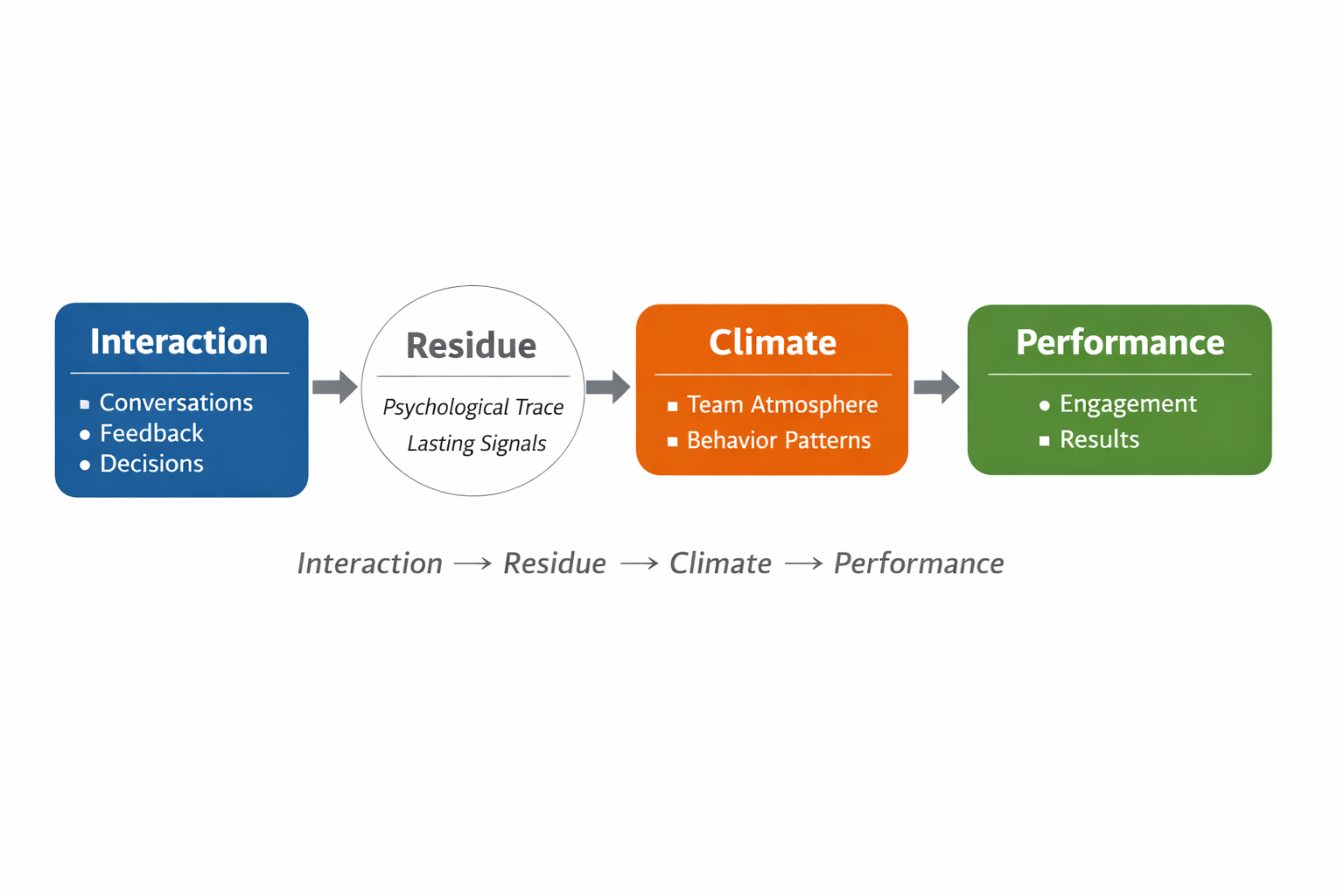
Climate is what people actually feel inside their team on a Tuesday afternoon. It is the emotional environment created by daily work interactions — meetings, conversations, decisions, questions, and reactions.
And climate is not formed by grand gestures. It is built one interaction at a time.
Every interaction leaves a trace.
A manager responds to a question with curiosity rather than impatience.
A teammate shares an idea and it is explored instead of dismissed.
A mistake is treated as information rather than failure.
None of these moments seems particularly significant on its own.
But each one leaves what might be called interaction residue — a small psychological signal that shapes how people interpret the next moment.
Over time, those signals accumulate.
The team begins to develop shared expectations about how work actually operates:
Is it safe to speak honestly?
Are new ideas explored or immediately evaluated?
Does effort get noticed?
Are questions welcomed or quietly discouraged?
These expectations form the team’s performance climate.
And once established, climate becomes self-reinforcing.
People adjust their behavior to match the signals they observe.
If curiosity is welcomed, curiosity increases.
If caution is rewarded, caution spreads.
If judgment appears quickly, people begin editing themselves before speaking.
The climate of the team quietly shifts — not through policy, but through interaction patterns.
Why Climate Matters More Than We Think
Most organizations try to improve performance through strategy, incentives, and structure.
Those things matter.
But they often overlook something far more immediate: the climate people are operating in every day.
Research across organizational psychology consistently shows that team climate strongly predicts learning, engagement, and performance. Teams with a climate of psychological safety, curiosity, and constructive challenge adapt faster and generate better outcomes.
The reason is simple.
Performance depends not only on skill and effort but on how much potential actually shows up in the room.
When the climate encourages openness, people bring more of their thinking to the work. They test ideas, ask questions, and explore possibilities.
When the climate discourages exposure, people protect themselves. They contribute less, speak cautiously, and avoid risk.
The same people.
The same strategy.
Very different performance.
The difference is climate.
Climate Is Easier to See Than Culture
Leaders sometimes assume climate is abstract or difficult to measure.
In reality, climate becomes visible through patterns of interaction.
You can see it in how meetings unfold.
Who speaks first.
Who asks questions.
Whether disagreement is explored or quickly resolved.
Whether managers react with curiosity or correction.
These patterns reveal where attention lives inside the team.
Are people focused on learning and exploration, or on avoiding error and judgment?
The answer determines how much interference people experience in their work.
And that brings us to an important point.
Climate doesn’t just influence engagement. It influences cognitive bandwidth.
When people operate in climates of evaluation and pressure, attention shifts inward. Energy goes toward monitoring, protecting, and managing impressions.
When the climate supports exploration, attention moves outward. Energy goes toward observing, experimenting, and learning.
The difference is subtle but powerful.
One climate amplifies potential.
The other quietly subtracts from it.
Why Managers Shape Climate
Senior leaders influence culture.
Managers shape climate.
They sit closest to the daily interactions where climate is formed. Their habits of listening, questioning, reacting, and deciding send constant signals about how work actually happens.
Often these signals are unintentional.
A quick dismissal of an idea.
A meeting that rewards updates instead of inquiry.
A focus on answers rather than exploration.
None of these moments seems consequential. Yet together they shape the atmosphere of the team.
Over time, teams adapt to the climate that emerges.
They either expand their contribution — or narrow it.
Before attempting to improve team climate, leaders need to see the one their daily interactions are already creating. Because climate forms gradually, most teams operate inside patterns they rarely stop to examine. Assessments such as Team Vital Signs surface these patterns, providing a practical starting point for conversations about how a team works—and how it could work better.
You can access sample data from a TVS report below. Time commitment from your team members is only 10 minutes. And cost varies from $1,800 to $5,700 depending on team size.


