
Change Happens Fast. Transition Doesn’t.
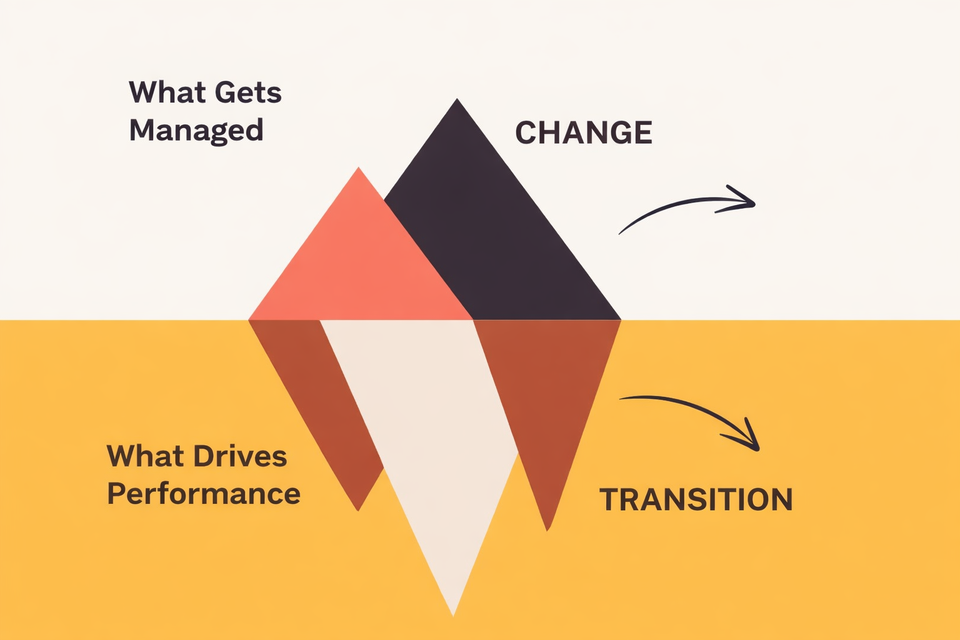
Organizations are good at creating change.
New strategies get announced.
Structures shift.
Priorities get reset.
Change happens quickly. And on paper, it can look clean and decisive.
But inside the team, something very different is happening. People are still catching up.
Change Is External. Transition Is Internal.
Change is what happens around us.
- A new direction.
- A new expectation
- A new way of working
- A new reporting structure
Transition is what happens within us.
It’s the process of:
- making sense of what changed
- letting go of how things worked before
- figuring out what matters now
Change can be communicated in a moment.
Transition has to be worked through.
Where Performance Actually Breaks Down
Most change efforts assume that once something is explained, people will adjust.
But performance doesn’t break down in change. It breaks down in unresolved transition.
People don’t move because something was explained well.
They move when they’ve worked their way through the shift.
When they can see:
- what’s different
- what still applies
- what they need to do now
Until that happens, their attention is scattered and performance becomes inconsistent.
The Hidden Work Inside Transition
During transition, attention splits. Part of it is on the work.
Part of it is on internal questions:
- “What does this mean for how I operate now?”
- “What actually matters most?”
- “What’s the right move here?”
Until those questions settle, people can’t fully commit to action.
Not because they don’t want to—but because they don’t yet have a clear internal reference point.
This is the part most organizations don’t see.
And it’s where performance is won or lost.
Why More Direction Doesn’t Solve It
The instinct during change is to increase direction:
More communication.
More guidance.
More answers.
It feels like progress from YOUR perspective.
But when people are in transition, more input often creates more noise.
Because the issue isn’t a lack of information.
It’s a lack of clear, owned understanding.
You can’t direct someone through a transition they haven’t processed.
A Different Way to Lead Through Change
Instead of pushing people forward, the work shifts.
From directing change to facilitating transition.
That starts with attention.
“What’s actually different for you right now?”
“What’s still unclear?”
“What are you trying to figure out?”
These aren’t soft questions.
They’re practical because they surface the reality people are actually working inside of.
And once that becomes visible, clarity starts to form—and performance begins to follow.
If this resonates, share it with someone navigating change—it might help them make sense of what they’re working through.


